
Creating an Arper account enables you to access the latest news and product launches.
If you are an architect or a dealer it enables you to access exclusive file downloads or, if you are a member of the press, to access high-resolution images and other press material. Also, you'll automatically be able to save items in your cart and access your cart from one visit to the next.
What does it mean to make an edition? Is it necessary to recreate the object identically? Follow the steps of the past in lockstep and forgo the innovations of the present? Is it more important to keep the spirit of the original or its original technical attributes? How closely linked are ideas and ideals to technical processes?
We construct our living spaces around ideas: of how we want to live, what we want to do or accomplish, who we want to be. Space supports our lives not only in reality, but in image. The environment around us is a prompt and a reminder of where we’ve been and where we hope to go.
Every two years, for an entire weekend, the old factories of Langenthal – a small town in the canton of Bern in Switzerland – become the stage for exhibitions dedicated to contemporary design: it is the “Designer’s Saturday”, now at its 14th year.
Design does not exist on paper or screen alone. It is meant to be made, built, put into use and lived. Loved, even. Through this process, design becomes more than concept or philosophy – it becomes a living system to better our lives, a conversation.
Arper supports the British Pavilion at 13th Venice Architecture Biennale, curated by Vicky Richardson, Director of Architecture, Design and Fashion at the British Council and Vanessa Norwood, Head of Exhibitions at the Architectural Association.
Welcome to our manufacturing plant in Treviso. The building, located across the street from the historic home of Arper’s headquarters is a kind of atelier nestled in the surrounding countryside.
Some ideas endure. We find traces of the same thought repeated throughout human record, mimicked across disciplines. And so the thought becomes more than an idea — it becomes a concept, a meme, an archetype.
Experiments in technology are necessary for advancing the process of innovation — going beyond current limits, opening new possibilities. The driving force is the question of what a machine is capable of beyond the human hand.
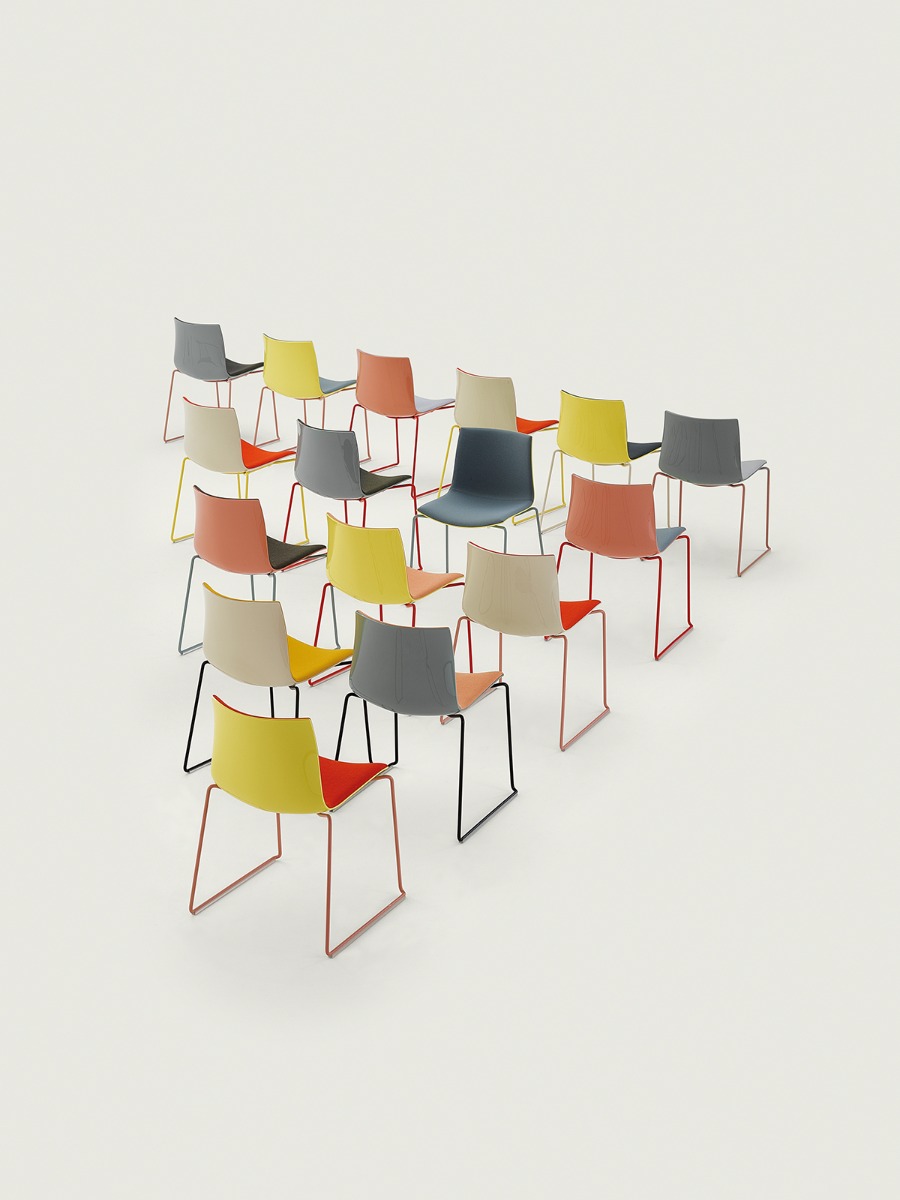
Premiering at the 2012 Salone de Mobile in Milan, Arper is pleased to introduce Brief No. 2. Titled “Living Systems” this Brief takes a more in-depth look at Arper and its furniture as a living system of bases, shells, materials, color and contexts.
Arper Brief No. 2 is based around the idea of Living Systems — a way of thinking about design where a system is generated by the conditions of life and human interaction.
Touching realms as broad as ecology, nature, landscape, play, agriculture and urbanism, Living Systems is a different way to think about design as a series of flows for information, energy and matter, not imposed from above but self-organizing.
At Arper, we think about our work in many ways: about what elements or places influence and inspire us, and how that influence grows into larger ideas. But, just as important is the consideration of our work in place – how our objects join, blend, and become part of the place they are in. So it is always a good experience to see our pieces in place, and to experience how they become part of the spaces and lives that they join.
The Messner Mountain Museum, born of the passion of Mountaineer and Statesman Reinold Messner, is dedicated to man’s encounter with mountains. The museum complex is comprised of five small museum buildings located throughout the Alps, each with individual exhibitions, all devoted to the intimate relationship between man and the mountains throughout the centuries and the world.
The Topography of Terror is a museum and memorial located in Berlin at the site of the national headquarters of the SS and Gestapo program of persecution and annihilation, dedicated to presenting and understanding the European dimensions of the Nazi reign of terror.
Although the title “Designers’ Saturday” sounds modest enough, this biannual event in the small town of Langenthal, in Switzerland, is a big deal to design aficionados. Langenthal opens up raw spaces in industrial factories to the fantasy of jury-selected exhibitors, who feature their products in artfully designed installations.
Is it a physical attribute—a similarity in looks, a variation on a visual theme that links its members together? Or is it something deeper? A shared history and outlook that leads to a way of navigating the world that’s recognizably unique?
The creative team of photographer Maurice Scheltens and visual artist Liesbeth Abbenes focuses on still-life photography both as artistic endeavor and communicative medium. Together with studios 2×4 and Lievore Altherr Molina, the Amsterdam-based couple are responsible for the new images of Arper products displayed on this site.
For the British Pavilion at the the Venice Architecture Biennale 2010 the theme was Venice itself. Artistic director MUF architecture/art declared that the only items we should take from the UK should be eight small notebooks created by John Ruskin in the 19th century. Borrowed from the Ruskin Library at Lancaster University, Ruskin originally bought the notebooks in Venice and used them for research towards his great book, The Stones of Venice.
There is something remarkable about the loping, anthropomorphic forms of Calder and Smith passing blithely through the fields of Storm King Art Center. Their presence feels almost natural, though their scale and fierce materiality are anything but.
City Bakery has opened an outpost of their famous Birdbath Café on the ground floor of the New Museum on the Bowery. Arper Leaf chairs surround the café’s square and communal tables, creating a gathering place for museum visitors and the creative community of New York City.